
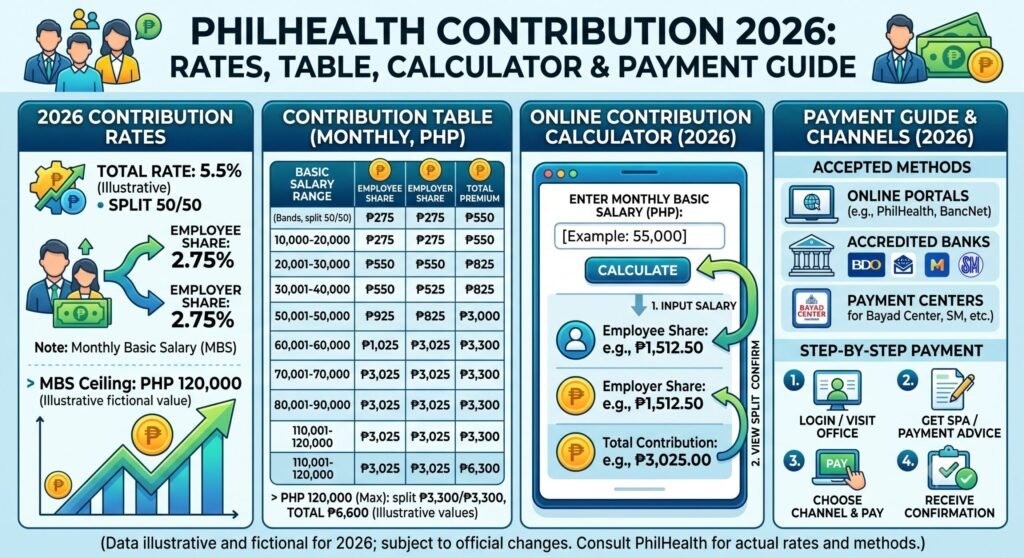
PhilHealth Contribution 2026: Rates, Table & Calculator
Understanding your PhilHealth Contribution is one of the best ways to prepare for unexpected medical expenses and protect your family’s future. Whether you’re an employee, freelancer, business owner, or overseas worker, making regular contributions helps you maintain active PhilHealth coverage and access essential PhilHealth benefits when you need them most.
From reducing hospital costs to supporting treatments for serious illnesses, PhilHealth plays a vital role in providing affordable healthcare across the Philippines. In this guide, you’ll learn the latest contribution rates, payment options, computation methods, and eligibility requirements in simple language. By staying informed and paying on time, you can enjoy reliable Healthcare coverage while building a secure financial safety net through your PhilHealth membership.

2. What Is PhilHealth Contribution?
A PhilHealth contribution is the monthly premium that members pay to the Philippine Health Insurance Corporation (PhilHealth). These contributions help finance the country’s universal healthcare programme, making medical services more affordable for Filipinos. The amount you pay depends on your monthly income and membership category.
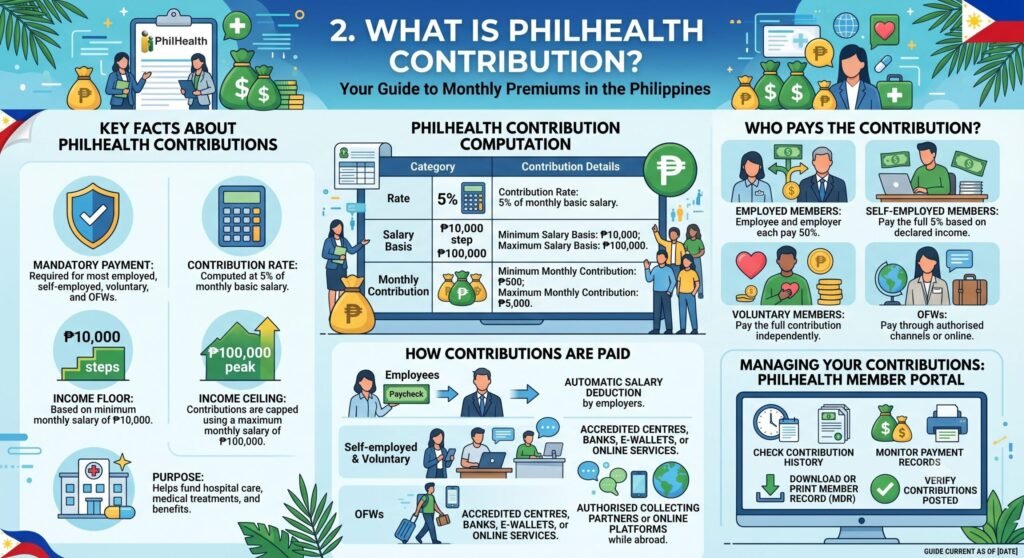
Key Facts About PhilHealth Contributions
- Mandatory payment: Required for most employed, self-employed, voluntary, and overseas Filipino workers.
- Contribution rate: Computed at 5% of the monthly basic salary.
- Income floor: Based on a minimum monthly salary of ₱10,000.
- Income ceiling: Contributions are capped using a maximum monthly salary of ₱100,000.
- Purpose: Helps fund hospital care, medical treatments, and other PhilHealth benefits.
PhilHealth Contribution Computation
| Category | Contribution Details |
|---|---|
| Contribution Rate | 5% of monthly basic salary |
| Minimum Salary Basis | ₱10,000 |
| Maximum Salary Basis | ₱100,000 |
| Minimum Monthly Contribution | ₱500 |
| Maximum Monthly Contribution | ₱5,000 |
Who Pays the Contribution?
| Membership Type | Payment Responsibility |
|---|---|
| Employed Members | Employee and employer each pay 50% of the total contribution. |
| Self-Employed Members | Pay the full 5% based on declared monthly income. |
| Voluntary Members | Pay the full contribution independently. |
| OFWs | Pay through authorised payment channels or online services. |
How Contributions Are Paid
- Employees: Contributions are automatically deducted from monthly salaries and remitted by employers.
- Self-employed and voluntary members: Payments can be made through accredited payment centres, banks, e-wallets, or PhilHealth’s online services.
- OFWs: Can pay using authorised collecting partners or online payment platforms while abroad.
Managing Your Contributions
After making payments, members can access the PhilHealth Member Portal to:
- Check their contribution history.
- Monitor payment records.
- Download or print their Member Data Record (MDR).
- Verify that contributions have been successfully posted.
Paying your PhilHealth contributions regularly helps keep your membership active and ensures you remain eligible for healthcare benefits whenever you need medical assistance.
3. Who Needs to Pay PhilHealth Contributions?
Under the Universal Health Care (UHC) Act, most Filipinos are required to register with PhilHealth. However, only direct contributors are required to make regular premium payments. The payment rules depend on your employment status, income source, and membership category.
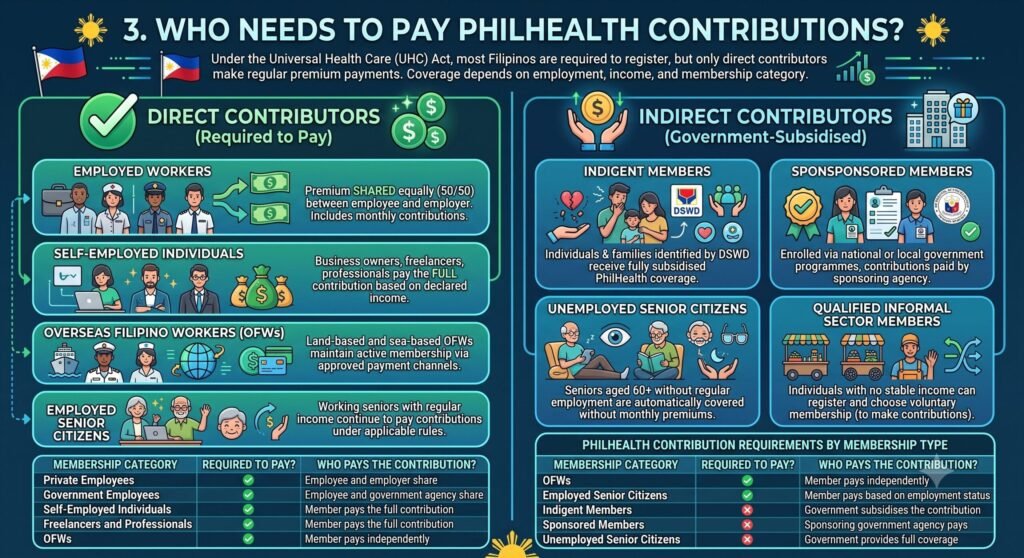
Direct Contributors (Required to Pay)
The following members must pay PhilHealth contributions to maintain active coverage:
- Employed workers: Employees in both the public and private sectors contribute monthly. The premium is shared equally between the employee and the employer.
- Self-employed individuals: Business owners, freelancers, professionals, and sole proprietors pay the full contribution based on their declared monthly income.
- Overseas Filipino Workers (OFWs): Both land-based and sea-based OFWs are required to maintain active PhilHealth membership by paying their contributions through approved payment channels.
- Employed senior citizens: Seniors who are still working or earning a regular income continue to pay PhilHealth contributions under the applicable rules.
Indirect Contributors (Government-Subsidised)
Some members receive PhilHealth coverage without paying regular premiums because the government covers their contributions.
- Indigent members: Individuals and families identified by the Department of Social Welfare and Development (DSWD) receive fully subsidised PhilHealth coverage.
- Sponsored members: People enrolled through national or local government programmes have their contributions paid by the sponsoring agency.
- Unemployed senior citizens: Seniors aged 60 and above without regular employment or income are automatically covered without paying monthly premiums.
- Qualified informal sector members: Individuals with no stable source of income may register with PhilHealth and can choose voluntary membership if they wish to make regular contributions.
PhilHealth Contribution Requirements by Membership Type
| Membership Category | Required to Pay? | Who Pays the Contribution? |
|---|---|---|
| Private Employees | Yes | Employee and employer share the payment |
| Government Employees | Yes | Employee and government agency share the payment |
| Self-Employed Individuals | Yes | Member pays the full contribution |
| Freelancers and Professionals | Yes | Member pays the full contribution |
| Overseas Filipino Workers (OFWs) | Yes | Member pays independently |
| Employed Senior Citizens | Yes | Member pays based on employment status |
| Indigent Members | No | Government subsidises the contribution |
| Sponsored Members | No | Sponsoring government agency pays |
| Unemployed Senior Citizens | No | Government provides full coverage |
Keeping your membership category up to date ensures you pay the correct contribution amount and remain eligible for PhilHealth benefits whenever you need medical care.
4. PhilHealth Contribution Rate for 2026
The PhilHealth contribution rate for 2026 remains 5% of the monthly basic salary. This rate applies to qualified members under the Universal Health Care (UHC) programme. The amount you pay depends on your monthly income, with a minimum salary basis of ₱10,000 and a maximum salary basis of ₱100,000. Employees split the contribution with their employers, while self-paying members cover the full amount themselves.
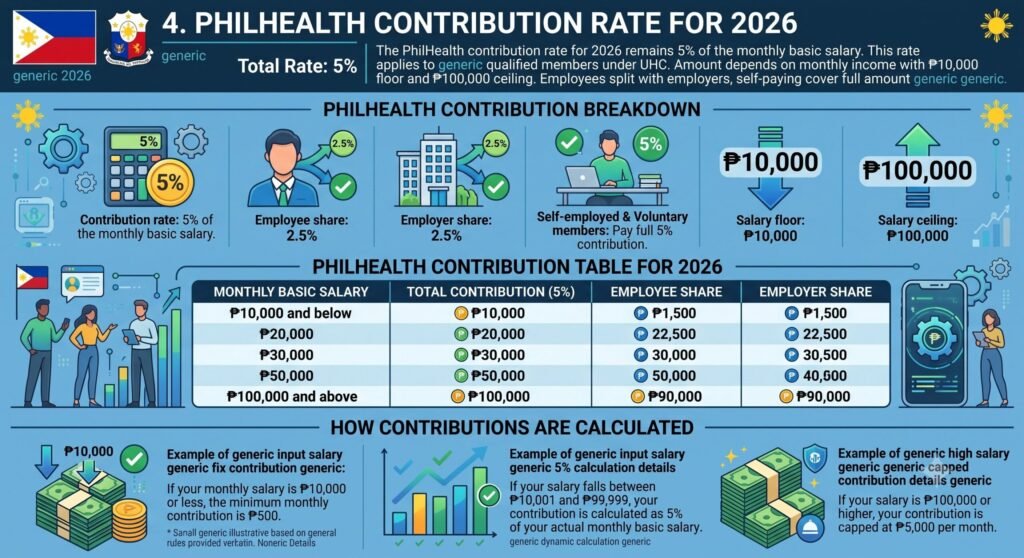
PhilHealth Contribution Breakdown
- Contribution rate: 5% of the monthly basic salary.
- Employee share: 2.5% of the monthly salary.
- Employer share: 2.5% of the monthly salary.
- Self-employed and voluntary members: Pay the full 5% contribution.
- Salary floor: ₱10,000.
- Salary ceiling: ₱100,000.
PhilHealth Contribution Table for 2026
| Monthly Basic Salary | Total Contribution (5%) | Employee Share | Employer Share |
|---|---|---|---|
| ₱10,000 and below | ₱500 | ₱250 | ₱250 |
| ₱20,000 | ₱1,000 | ₱500 | ₱500 |
| ₱30,000 | ₱1,500 | ₱750 | ₱750 |
| ₱50,000 | ₱2,500 | ₱1,250 | ₱1,250 |
| ₱100,000 and above | ₱5,000 | ₱2,500 | ₱2,500 |
How Contributions Are Calculated
- If your monthly salary is ₱10,000 or less, the minimum monthly contribution is ₱500.
- If your salary falls between ₱10,001 and ₱99,999, your contribution is calculated as 5% of your actual monthly basic salary.
- If your salary is ₱100,000 or higher, your contribution is capped at ₱5,000 per month.
Important Payment Reminder for Self-Paying Members
Self-employed individuals, voluntary members, freelancers, professionals, and some Overseas Filipino Workers (OFWs) should note the “No SPA, No Payment” policy before making a contribution.
- Generate a Statement of Premium Account (SPA) through the PhilHealth Member Portal or the SPA Generator.
- The SPA includes a QR code required for payment processing.
- Present or use the SPA when paying through authorised banks, payment centres, or online channels.
- Always keep your payment receipt or confirmation for future reference.
Following the correct contribution rate and payment process helps keep your PhilHealth membership active and ensures continuous access to healthcare benefits when you need them.
5. PhilHealth Contribution Table 2026
The official **PhilHealth contribution table provides a quick way to estimate how much members should contribute every month. Instead of guessing your payment, you simply locate your income bracket and apply the required percentage. This table helps employers, payroll officers, freelancers, and individual members calculate contributions correctly while avoiding payment errors.
Although contribution rates may change whenever new government policies take effect, checking the latest PhilHealth contribution chart before making payments is always a good habit. Doing so ensures your Contribution record remains accurate and reduces delays during future Contribution verification or benefit claims.
| Monthly Salary | Contribution Rate | Total Monthly Premium | Employee Share | Employer Share |
|---|---|---|---|---|
| ₱10,000 | 5.5% | ₱550 | ₱275 | ₱275 |
| ₱20,000 | 5.5% | ₱1,100 | ₱550 | ₱550 |
| ₱30,000 | 5.5% | ₱1,650 | ₱825 | ₱825 |
| ₱40,000 | 5.5% | ₱2,200 | ₱1,100 | ₱1,100 |
| ₱50,000 | 5.5% | ₱2,750 | ₱1,375 | ₱1,375 |
6. How PhilHealth Contributions Are Computed
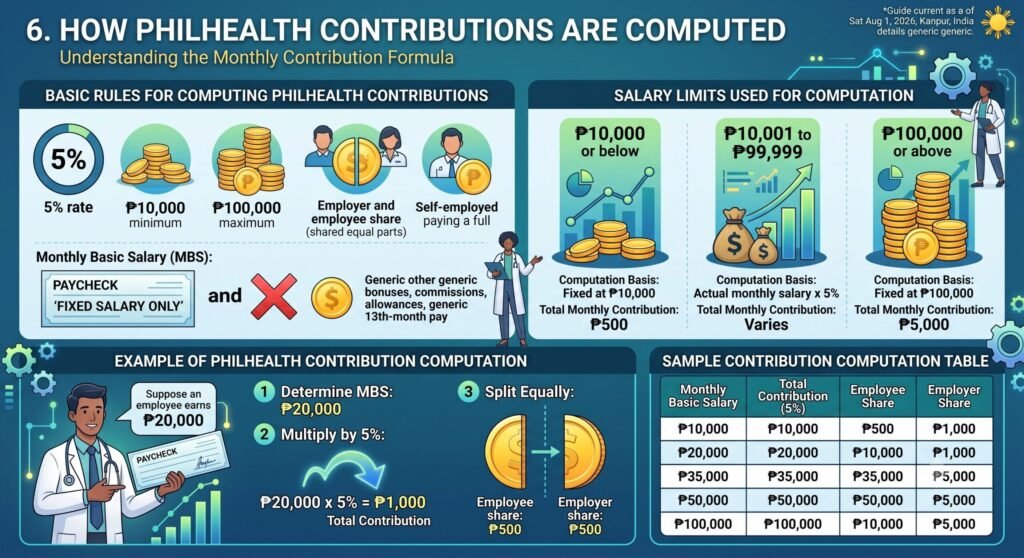
PhilHealth calculates your monthly contribution using a simple formula based on your monthly basic salary (MBS). The contribution rate is 5% of your monthly basic pay, but the computation follows a minimum income base of ₱10,000 and a maximum income base of ₱100,000. For employees, the total premium is shared equally between the employee and the employer. Self-employed and voluntary members pay the full contribution on their own.
Basic Rules for Computing PhilHealth Contributions
- Contribution rate: 5% of the monthly basic salary.
- Minimum income base: ₱10,000.
- Maximum income base: ₱100,000.
- Employees: The total premium is divided equally between the employee and employer.
- Self-employed and voluntary members: Pay the full computed contribution.
- Monthly Basic Salary (MBS): Includes only the fixed monthly salary. It does not include overtime pay, commissions, allowances, bonuses, or 13th-month pay.
Salary Limits Used for Computation
| Monthly Basic Salary | Computation Basis | Total Monthly Contribution |
|---|---|---|
| ₱10,000 or below | Fixed at ₱10,000 | ₱500 |
| ₱10,001 to ₱99,999 | Actual monthly salary × 5% | Varies |
| ₱100,000 or above | Fixed at ₱100,000 | ₱5,000 |
Example of PhilHealth Contribution Computation
Suppose an employee earns a monthly basic salary of ₱20,000.
- Determine the monthly basic salary: ₱20,000.
- Multiply the salary by 5%: ₱20,000 × 5% = ₱1,000.
- Split the contribution equally:
- Employee share: ₱500
- Employer share: ₱500
Sample Contribution Computation Table
| Monthly Basic Salary | Total Contribution (5%) | Employee Share | Employer Share |
|---|---|---|---|
| ₱10,000 | ₱500 | ₱250 | ₱250 |
| ₱20,000 | ₱1,000 | ₱500 | ₱500 |
| ₱35,000 | ₱1,750 | ₱875 | ₱875 |
| ₱50,000 | ₱2,500 | ₱1,250 | ₱1,250 |
| ₱100,000 | ₱5,000 | ₱2,500 | ₱2,500 |
Computation for Self-Employed and Voluntary Members
Self-employed individuals, freelancers, professionals, and voluntary members calculate their contribution using the same 5% rate based on their declared monthly income.
- They pay the entire contribution without employer sharing.
- The declared income must fall within the ₱10,000 to ₱100,000 computation range.
- Payments can be made through authorised PhilHealth payment channels after generating the required Statement of Premium Account (SPA).
By understanding how PhilHealth contributions are computed, you can estimate your monthly premium accurately, avoid payment errors, and ensure your membership remains active for uninterrupted healthcare benefits.
7. PhilHealth Contribution by Membership Type
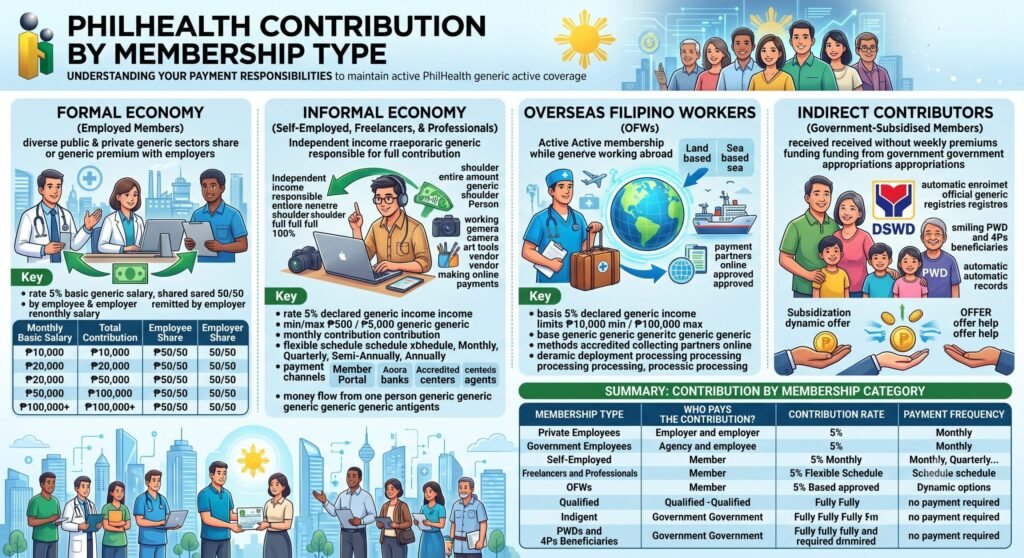
PhilHealth contribution rules vary depending on your membership category. While the 5% contribution rate applies to most direct contributors, the payment responsibility differs for employees, self-employed individuals, Overseas Filipino Workers (OFWs), and government-subsidised members. Understanding your category helps you pay the correct amount and maintain active PhilHealth coverage.
Formal Economy (Employed Members)
Employees in the public and private sectors share the monthly PhilHealth premium with their employers.
- Contribution rate: 5% of the monthly basic salary.
- Payment sharing: 50% paid by the employee and 50% paid by the employer.
- Salary deduction: The employee’s share is automatically deducted from the monthly salary.
- Employer responsibility: Employers remit the total contribution directly to PhilHealth.
| Monthly Basic Salary | Total Contribution | Employee Share | Employer Share |
|---|---|---|---|
| ₱10,000 | ₱500 | ₱250 | ₱250 |
| ₱20,000 | ₱1,000 | ₱500 | ₱500 |
| ₱50,000 | ₱2,500 | ₱1,250 | ₱1,250 |
| ₱100,000 and above | ₱5,000 | ₱2,500 | ₱2,500 |
Informal Economy (Self-Employed, Freelancers, and Professionals)
Individuals who earn income independently are responsible for paying the entire PhilHealth contribution themselves.
- Full payment: Members shoulder 100% of the contribution.
- Contribution rate: 5% of the declared monthly income.
- Minimum monthly contribution: ₱500.
- Maximum monthly contribution: ₱5,000.
- Payment options: Monthly, quarterly, semi-annually, or annually.
- Payment channels: PhilHealth Member Portal, accredited banks, payment centres, and authorised collecting agents.
Overseas Filipino Workers (OFWs)
OFWs must maintain active PhilHealth membership while working abroad.
- Applicable to: Land-based and sea-based OFWs.
- Contribution basis: 5% of the declared monthly income.
- Income limits: Computed using the ₱10,000 minimum and ₱100,000 maximum salary base.
- Payment methods: Accredited collecting partners, online payment channels, or during deployment processing.
Indirect Contributors (Government-Subsidised Members)
Certain qualified groups receive PhilHealth coverage without paying monthly premiums because their contributions are funded by the government.
- No personal contribution required.
- Coverage is fully subsidised through government appropriations.
- Eligible groups include:
- Indigent families identified by the DSWD.
- Senior citizens without regular income.
- Persons with Disabilities (PWDs) who qualify under government programmes.
- Pantawid Pamilyang Pilipino Program (4Ps) beneficiaries.
- Automatic enrolment is usually based on government records and official registries.
PhilHealth Contribution by Membership Category
| Membership Type | Who Pays the Contribution? | Contribution Rate | Payment Frequency |
|---|---|---|---|
| Private Employees | Employee and employer | 5% (shared equally) | Monthly |
| Government Employees | Employee and agency | 5% (shared equally) | Monthly |
| Self-Employed | Member | 5% | Monthly, quarterly, semi-annually, or annually |
| Freelancers and Professionals | Member | 5% | Flexible payment schedule |
| Overseas Filipino Workers (OFWs) | Member | 5% | Based on approved payment options |
| Senior Citizens (Qualified) | Government | Fully subsidised | No payment required |
| Indigent Members | Government | Fully subsidised | No payment required |
| PWDs and 4Ps Beneficiaries | Government | Fully subsidised | No payment required |
Choosing the correct membership category ensures your contributions are calculated accurately, your records remain updated, and you continue enjoying PhilHealth benefits without interruption.
8. PhilHealth Contribution Calculator
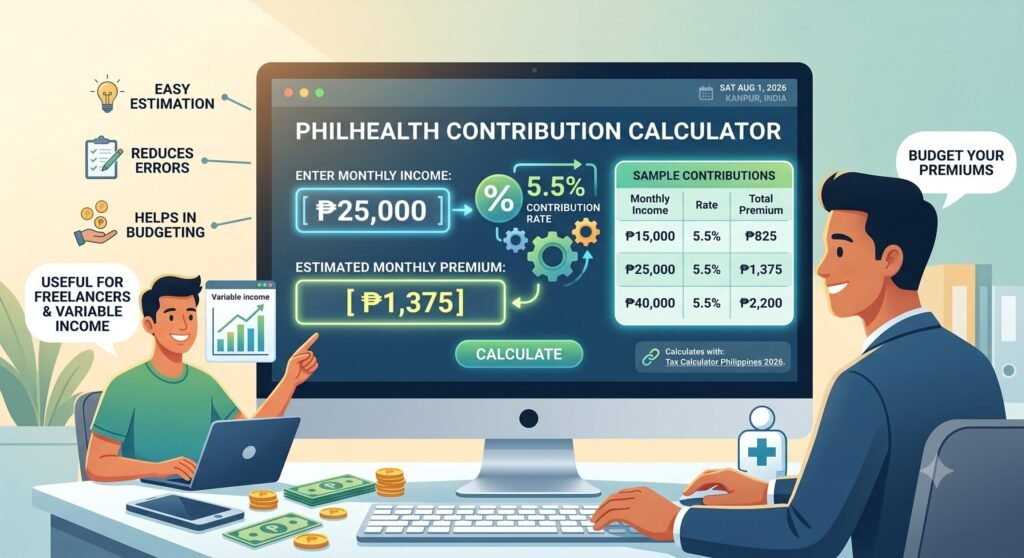
A PhilHealth contribution calculator helps you estimate your monthly premium without doing the maths yourself. Simply enter your monthly income, and the calculator applies the correct PhilHealth contribution percentage. It’s especially useful if your salary changes often or if you’re a freelancer with varying earnings.
Many members use online calculators before making a PhilHealth payment. This simple tool reduces errors in PhilHealth contribution computation and helps you budget your monthly PhilHealth premium. You can also compare different salary levels and understand how income changes affect your contribution amount.
For Calculation You May use this tool: Tax Calculator Philippines 2026
Sample Contribution Calculator
| Monthly Income | Contribution Rate | Total Premium |
|---|---|---|
| ₱15,000 | 5.5% | ₱825 |
| ₱25,000 | 5.5% | ₱1,375 |
| ₱40,000 | 5.5% | ₱2,200 |
Remember, a calculator provides an estimate. Always compare the result with the official PhilHealth contribution chart before making a payment.
9. How to Pay PhilHealth Contributions
Paying your PhilHealth Contribution has become much easier thanks to digital services. Employees don’t need to do anything because their employers deduct contributions automatically. Independent members have several convenient options, making it possible to complete a PhilHealth online payment without visiting an office.
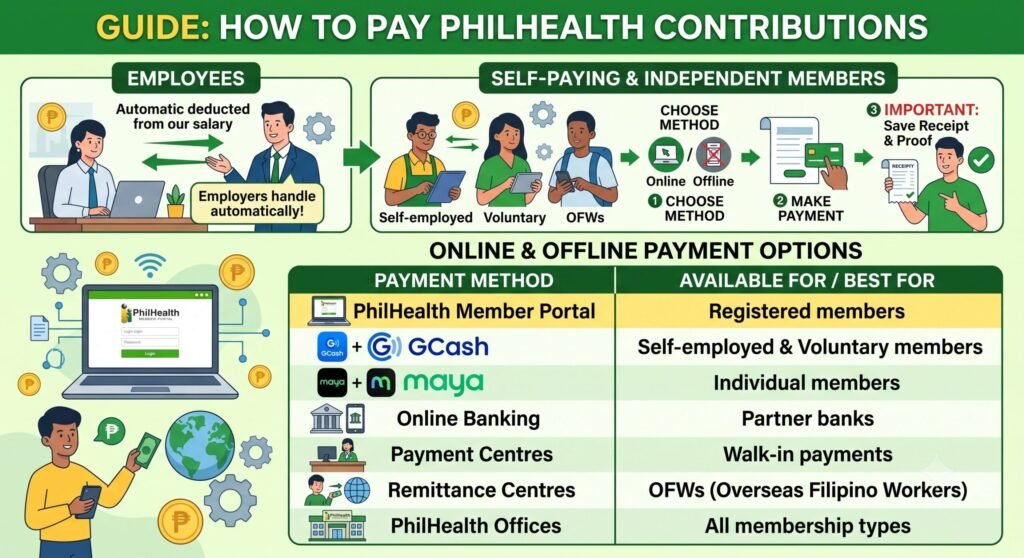
If you’re paying on your own, you can use GCash, Maya, Online banking, accredited Payment centres, or authorised Remittance centres. These PhilHealth contribution payment methods allow you to pay anytime while keeping your membership active. After every transaction, save your PhilHealth contribution receipt and PhilHealth payment proof in case you need them later.
Online and Offline Payment Options
| Payment Method | Available For |
|---|---|
| PhilHealth Member Portal | Registered members |
| GCash | Self-employed and voluntary members |
| Maya | Individual members |
| Online banking | Partner banks |
| Payment centres | Walk-in payments |
| Remittance centres | OFWs |
| PhilHealth offices | All membership types |
Paying online saves time and lets you monitor your transactions more easily. If you’re wondering how to pay PhilHealth online, choose an authorised payment partner and follow the instructions carefully to avoid posting delays.
10. PhilHealth Contribution Payment Schedule
Every member should know the official PhilHealth payment schedule. Paying on time prevents late PhilHealth payment issues and helps maintain your PhilHealth coverage. Employees don’t usually worry because employers submit contributions monthly through payroll. However, self-paying members must remember their own due dates.
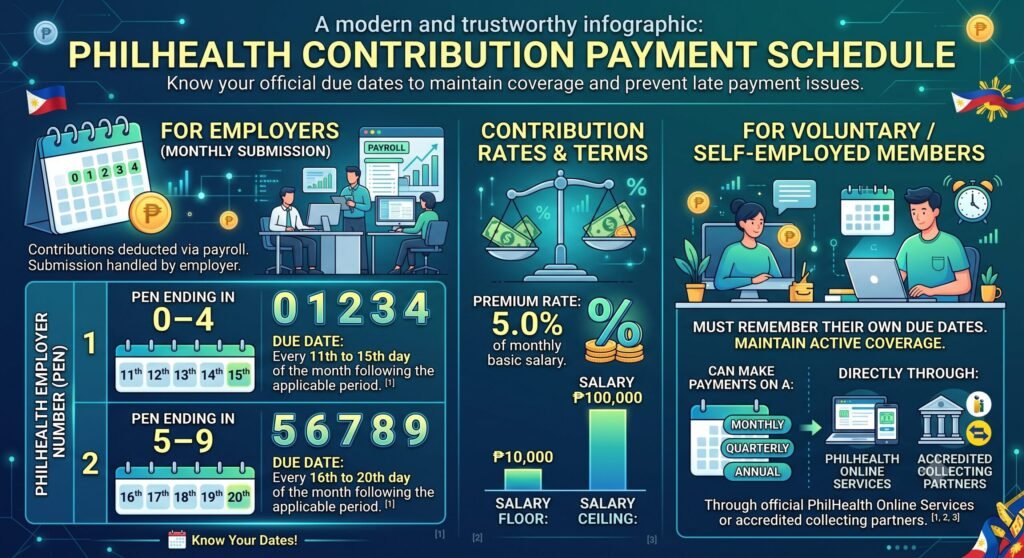
PhilHealth monthly payment deadlines for employers depend on the last digit of their PhilHealth Employer Number (PEN): numbers ending in 0-4 must pay by the 11th–15th day, and numbers ending in 5-9 must pay by the 16th–20th day of the month following the applicable period.
Employer Payment Deadlines
- PEN Ending in 0–4: Every 11th to 15th day of the month following the applicable period.
- PEN Ending in 5–9: Every 16th to 20th day of the month following the applicable period. [1]
Contribution Rates and Terms
- Premium Rate: 5.0% of the monthly basic salary.
- Salary Floor & Ceiling: ₱10,000 (floor) and ₱100,000 (ceiling).
- Voluntary/Self-Employed Members: Can make payments on a monthly, quarterly, or annual schedule directly through official PhilHealth Online Services or accredited collecting partners.
11. How to Check PhilHealth Contributions Online
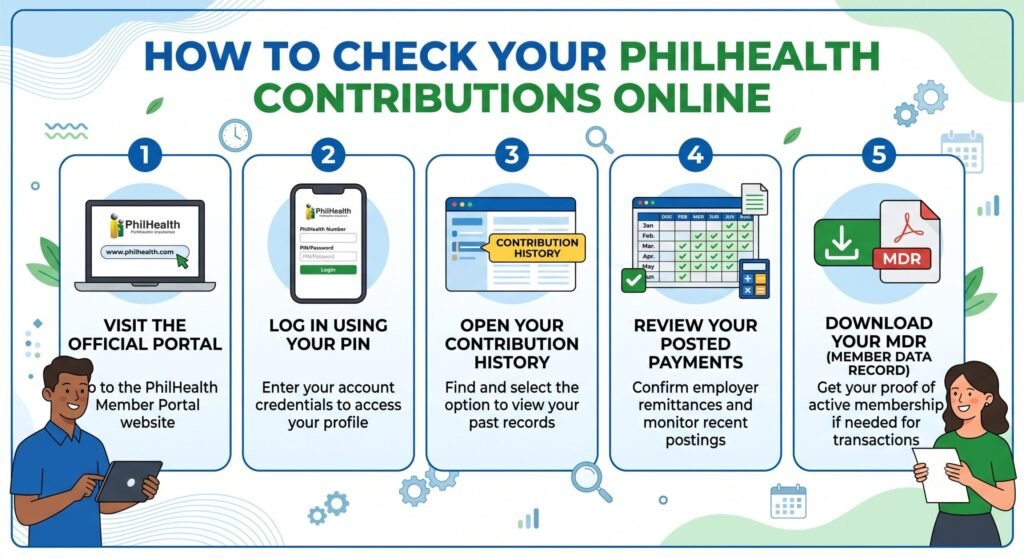
Checking your PhilHealth Contribution online only takes a few minutes. The official PhilHealth Member Portal allows members to review their Contribution history, monitor payment postings, and confirm that employer remittances have been credited correctly. Regular checks help you spot missing payments before they become bigger problems.
To check PhilHealth contributions online, log in using your PhilHealth account and PhilHealth PIN. After signing in, open your payment history to review your Contribution records. You can also download your Member Data Record (MDR), which serves as proof of active membership for many PhilHealth transactions.
Viewing Your Contribution History
| Step | Action |
|---|---|
| 1 | Visit the official PhilHealth online portal |
| 2 | Log in using your PhilHealth PIN |
| 3 | Open your contribution history |
| 4 | Review your posted payments |
| 5 | Download your Member Data Record (MDR) if needed |
If you notice missing contributions, contact PhilHealth or your employer immediately. Fixing errors early helps avoid delays when claiming future healthcare benefits in the Philippines or applying for medical reimbursement.
12. What Happens If You Miss PhilHealth Contributions?
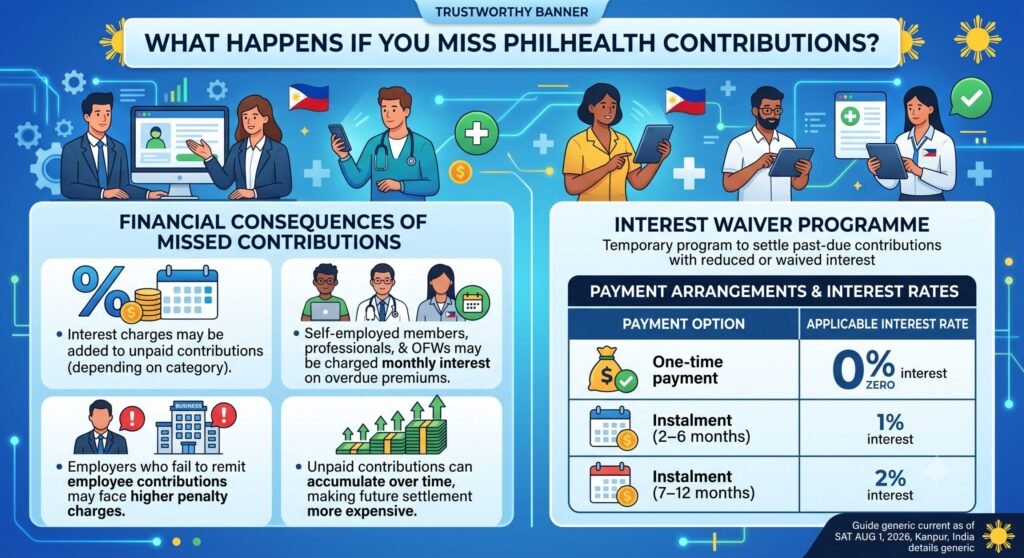
Missing your PhilHealth contributions does not automatically cancel your membership. However, unpaid premiums can lead to additional charges, accumulated arrears, and the need to settle missed payments. Direct contributors are still responsible for paying any outstanding contributions to keep their records accurate and compliant with PhilHealth rules.
Financial Consequences of Missed Contributions
If you fail to pay your contributions on time, you may face the following:
- Interest charges may be added to unpaid contributions, depending on your membership category.
- Self-employed members, professionals, and Overseas Filipino Workers (OFWs) may be charged monthly interest on overdue premiums.
- Employers who fail to remit employee contributions may also face higher penalty charges.
- Unpaid contributions can accumulate over time, making future settlement more expensive.
Interest Waiver Programme
PhilHealth has introduced a temporary programme that allows eligible members and employers to settle past-due contributions with reduced or waived interest under certain payment arrangements.
| Payment Option | Applicable Interest Rate |
|---|---|
| One-time payment | 0% interest |
| Instalment (2–6 months) | 1% interest |
| Instalment (7–12 months) | 2% interest |
This programme applies only during the approved implementation period and subject to PhilHealth guidelines.
Effect on PhilHealth Benefits
Even if you have missed contributions, your membership generally remains valid under current eligibility rules. However, direct contributors are still legally required to settle unpaid premiums and any applicable interest.
- Membership is not automatically terminated because of missed payments.
- Outstanding premiums may need to be paid before your account is considered up to date.
- Keeping your contribution records current helps prevent delays during future transactions.
- Regular payments make it easier to maintain good account standing.
How to Settle Missed Contributions
If you have unpaid premiums, you can update your account by following these steps:
- Visit the nearest PhilHealth office or Local Health Insurance Office (LHIO).
- Request a computation of your outstanding contributions.
- Pay the required amount through approved payment channels or available instalment options.
- Update your membership information if your employment or income status has changed.
- Keep all payment receipts as proof of settlement.
Summary of Missing PhilHealth Contributions
| Situation | Possible Result | Recommended Action |
|---|---|---|
| Missed monthly contribution | Outstanding balance and possible interest | Pay the unpaid amount promptly |
| Late employer remittance | Delay in updating contribution records | Coordinate with your employer and PhilHealth |
| Self-employed missed payments | Retroactive payment may be required | Visit a PhilHealth office for account assessment |
| Multiple unpaid contributions | Accumulated arrears | Consider available payment or instalment options |
Paying your PhilHealth contributions on time is the best way to avoid penalties, maintain accurate membership records, and ensure your account remains in good standing for future healthcare needs.
13. Benefits of Paying PhilHealth Contributions Regularly
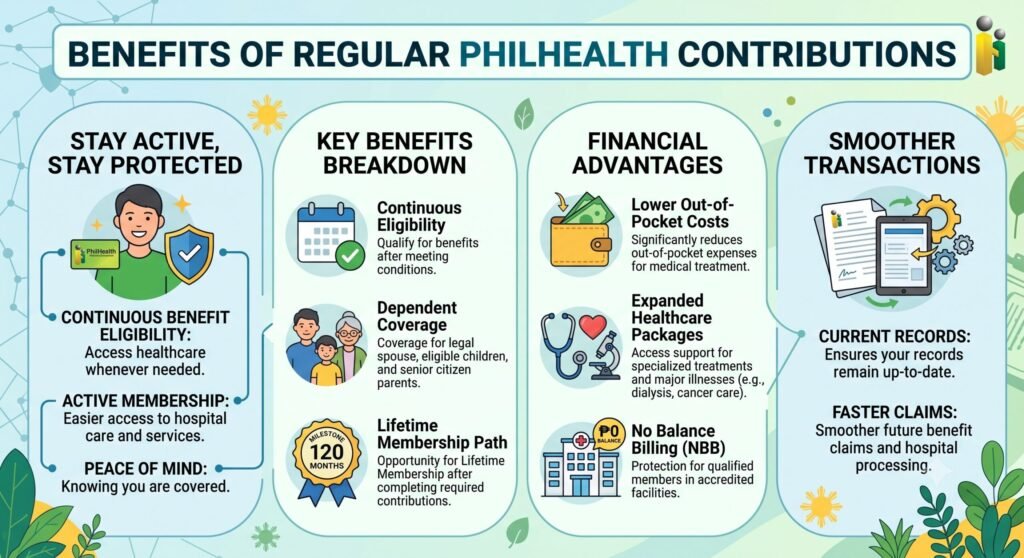
Paying your PhilHealth contributions on time helps you enjoy continuous healthcare protection and reduces the financial burden of medical treatment. Regular contributions keep your membership active, making it easier to access PhilHealth benefits whenever you need hospital care or approved medical services. Staying up to date also gives you greater peace of mind, knowing that you and your qualified dependents have access to essential healthcare support.
Consistent contributions do more than maintain your membership. They can reduce your out-of-pocket medical expenses, provide access to enhanced benefit packages, and help you qualify for lifetime membership after meeting the required contribution period. Regular payments also ensure your records remain current, making future benefit claims and hospital transactions smoother.
Key Benefits of Regular PhilHealth Contributions
- Continuous benefit eligibility: Regular contributions help you qualify for PhilHealth benefits when you meet the required contribution conditions.
- Coverage for qualified dependents: Your legal spouse, eligible children, and qualified senior citizen parents may also receive healthcare benefits.
- Lifetime membership opportunity: Members who complete the required 120 monthly contributions may qualify for Lifetime Membership and no longer need to pay regular premiums after meeting the programme’s requirements.
- Financial protection: PhilHealth helps reduce the cost of approved medical treatments and hospital services.
- Access to expanded healthcare packages: Eligible members can receive support for specialised treatments and major illnesses.
Financial Advantages
Regular PhilHealth contributions can significantly lower your medical expenses through approved benefit packages and case rate payments.
- Helps reduce hospital charges before discharge.
- Covers eligible expenses such as room accommodation, medicines, laboratory tests, and professional fees, depending on the approved case.
- Provides financial support for treatments such as dialysis, selected heart procedures, cancer care, and other specialised medical services.
- Offers protection under the No Balance Billing (NBB) Policy for qualified members receiving care in participating government and accredited healthcare facilities, subject to PhilHealth guidelines.
Summary of PhilHealth Contribution Benefits
| Benefit | How It Helps |
|---|---|
| Continuous eligibility | Helps maintain access to PhilHealth healthcare benefits. |
| Coverage for dependents | Extends protection to eligible family members. |
| Lower hospital expenses | Reduces approved medical and hospital costs. |
| Access to specialised treatment | Supports selected high-cost procedures and critical illness packages. |
| Lifetime Membership | Eligible members may stop paying premiums after completing the required contributions. |
| No Balance Billing (where applicable) | Helps minimise additional hospital charges in participating facilities. |
Making your PhilHealth contributions regularly is a practical way to protect both your health and your finances. By keeping your payments up to date, you improve your access to quality healthcare, reduce unexpected medical expenses, and secure long-term benefits for yourself and your family.
14. Common PhilHealth Contribution Problems and Solutions
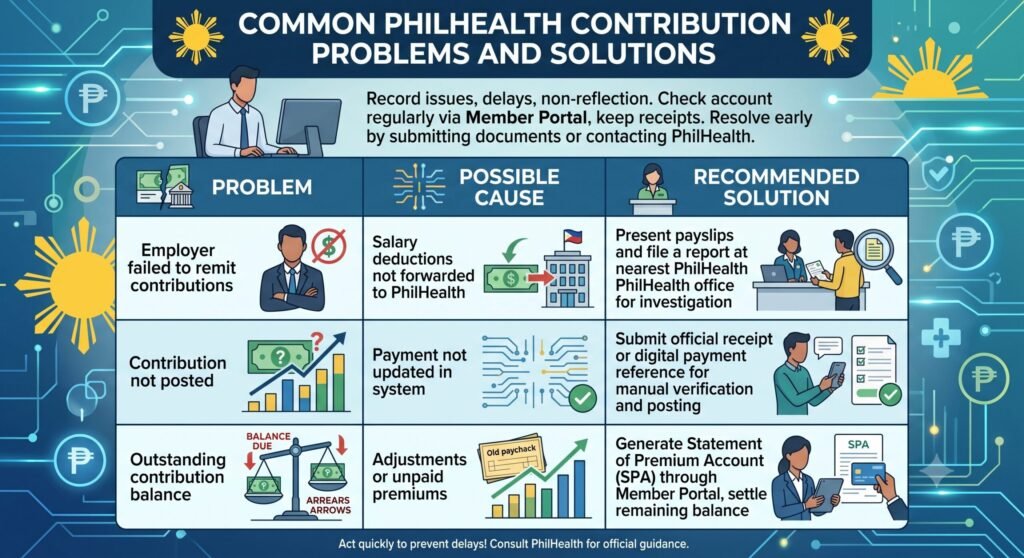
PhilHealth members may occasionally experience issues with their contribution records, especially when payments are delayed or not reflected in the system. These problems can affect your membership records and make it harder to verify your contribution history. Checking your account regularly through the PhilHealth Member Portal and keeping payment receipts can help you identify and resolve issues early.
Most contribution-related concerns can be corrected by submitting supporting documents or contacting the nearest PhilHealth office. Acting quickly helps prevent delays when applying for benefits or updating your membership information.
Common Problems and How to Fix Them
- Employer did not remit contributions: Your employer deducted your contribution from your salary but did not forward it to PhilHealth.
- Missing contribution records: Payments were made, but they do not appear in your contribution history.
- Outstanding contribution balance: Your account shows unpaid amounts due to changes in contribution rates or previous unpaid premiums.
Solutions for Common Issues
| Problem | Possible Cause | Recommended Solution |
|---|---|---|
| Employer failed to remit contributions | Salary deductions were not forwarded to PhilHealth | Present your payslips and file a report at the nearest PhilHealth office for investigation. |
| Contribution not posted | Payment has not yet been updated in the system | Submit your official receipt or digital payment reference for manual verification and posting. |
| Outstanding contribution balance | Previous contribution adjustments or unpaid premiums | Generate a Statement of Premium Account (SPA) through the Member Portal and settle the remaining balance. |
Tips to Avoid Contribution Problems
- Check your contribution history regularly through the PhilHealth Member Portal.
- Keep copies of official receipts, bank confirmations, or e-wallet transaction records.
- Review your payslip each month to confirm that PhilHealth deductions are accurate.
- Report missing or incorrect contribution records as soon as possible.
- Update your membership information whenever your employment or income status changes.
Resolving contribution issues early helps keep your PhilHealth records accurate, prevents delays during benefit claims, and ensures you continue receiving healthcare coverage without unnecessary interruptions.
15. Tips to Manage Your PhilHealth Contributions
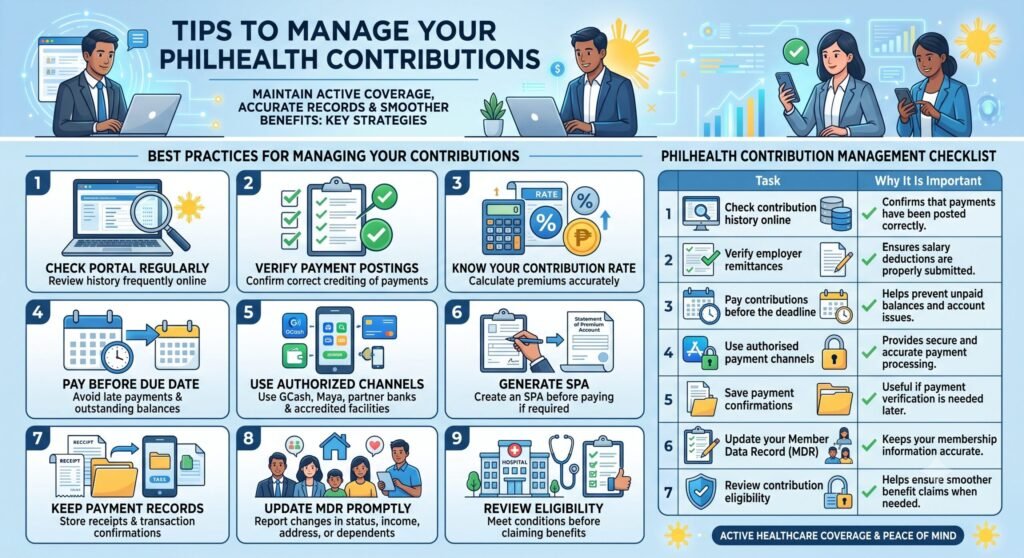
Managing your PhilHealth contributions properly helps you maintain active healthcare coverage and makes it easier to claim benefits when you need medical treatment. By monitoring your payments, paying on time, and keeping your membership information updated, you can avoid unnecessary delays and ensure your records remain accurate.
Regularly reviewing your contribution history is a good habit for every PhilHealth member. It allows you to spot missing payments early, correct errors quickly, and confirm that you meet the contribution requirements for future healthcare benefits.
Best Practices for Managing Your Contributions
- Check your contribution history regularly through the PhilHealth Member Portal.
- Verify payment postings to ensure your employer or personal payments have been credited correctly.
- Know your contribution rate so you can calculate the correct monthly premium.
- Pay before the due date to avoid missed contributions or outstanding balances.
- Use authorised online payment channels such as GCash, Maya, partner banks, or other accredited payment facilities.
- Generate a Statement of Premium Account (SPA) before paying if required for your membership category.
- Keep payment receipts and transaction records as proof of payment.
- Update your Member Data Record (MDR) whenever your employment status, income, address, or dependents change.
- Review your eligibility regularly to ensure you meet the required contribution conditions before using PhilHealth benefits.
PhilHealth Contribution Management Checklist
| Task | Why It Is Important |
|---|---|
| Check contribution history online | Confirms that payments have been posted correctly. |
| Verify employer remittances | Ensures salary deductions are properly submitted. |
| Pay contributions before the deadline | Helps prevent unpaid balances and account issues. |
| Use authorised payment channels | Provides secure and accurate payment processing. |
| Save payment confirmations | Useful if payment verification is needed later. |
| Update your Member Data Record (MDR) | Keeps your membership information accurate. |
| Review contribution eligibility | Helps ensure smoother benefit claims when needed. |
Stay Eligible for PhilHealth Benefits
To avoid delays when using your PhilHealth benefits, keep your membership information current and ensure your contributions are up to date.
- Report changes in employment, income, civil status, or dependents as soon as possible.
- Monitor your contribution records to identify any missing payments.
- Ensure you meet the required contribution period before planned hospitalisation or medical treatment.
- Contact PhilHealth immediately if you notice incorrect or incomplete records.
Taking a few minutes to manage your PhilHealth account regularly can save you time, reduce future problems, and help you enjoy continuous healthcare coverage whenever you and your family need it.
Also Read:
- PhilHealth Portal Login & Registration 2026: Complete Guide to Membership, Benefits, Contributions & Online Services
- PhilHealth ID: Your Complete July 2026 Guide
- PhilHealth Login 2026: Ultimate Guide to Member Portal, Password Reset & MDR Download
- PhilHealth Online Registration: Why 90% of Filipinos Get This One Step Wrong
- PhilHealth Employer Guide 2026: Registration & Compliance
- PhilHealth Online Appointment 2026: Step-by-Step Booking Secrets Revealed
- PhilHealth Requirements 2026: The One Document Everyone Forgets
Frequently Asked Questions About PhilHealth Contribution
How to avail of ₱20,000 PhilHealth benefits?
To avail of a PhilHealth benefit worth up to ₱20,000, you must be an active member with the required contribution eligibility for your medical condition. Receive treatment at a PhilHealth-accredited hospital or healthcare facility and present your PhilHealth ID or Member Data Record (MDR) upon admission. The actual amount covered depends on the approved case rate and the type of illness or procedure, not all members or treatments automatically qualify for a ₱20,000 benefit.
How much is the PhilHealth voluntary contribution for 2026?
For 2026, voluntary members generally pay a 5% premium based on their declared monthly income. The computation uses an income floor of ₱10,000 and a ceiling of ₱100,000. This means the monthly contribution ranges from ₱500 to ₱5,000. Unlike employed members, voluntary members pay the full amount themselves because there is no employer share.
What is the 3-month rule for PhilHealth?
The 3-month rule commonly refers to having at least three (3) months of paid premium contributions within the required eligibility period before using certain PhilHealth benefits. This requirement helps determine benefit eligibility for some claims. The exact contribution requirement may vary depending on current PhilHealth policies and the member’s category. Always verify the latest rules before filing a claim.
What happens if I don’t pay my PhilHealth for 2 years?
If you stop paying your PhilHealth contributions for two years, your membership usually remains on record, but unpaid contributions may affect your eligibility for certain benefits. You may need to settle applicable premiums or resume regular payments before qualifying for some services. Your PhilHealth Identification Number (PIN) remains the same, and you can update your membership once you continue contributing.
Can I withdraw all my contributions in PhilHealth?
No. PhilHealth is a national health insurance program, not a savings or investment account. The contributions you pay are used to fund healthcare benefits for all members and cannot be withdrawn as cash. Instead of receiving a refund, members use their contributions to access PhilHealth-covered medical services when eligible.
How to avail of ₱20,000 PhilHealth benefits?
Some PhilHealth primary care packages provide benefits that include maintenance medicines and healthcare services with limits that may reach ₱20,000 per year, depending on program eligibility. Members usually need to enroll with an accredited primary care provider and maintain an active PhilHealth membership. Eligibility depends on the specific benefit package and current PhilHealth guidelines.
Can you pay PhilHealth contributions in lump sum?
Yes. Depending on your membership category and available payment options, you may pay multiple contribution periods in one transaction after generating the required payment reference or statement. Many members choose this option for convenience. Always check the latest PhilHealth payment guidelines before making advance payments.
How much will PhilHealth cover for hospitalization?
PhilHealth does not provide one fixed hospitalization amount for every illness. The coverage depends on the medical condition, treatment received, hospital classification, and the applicable benefit package or case rate. Benefits may include room charges, medicines, laboratory tests, and professional fees based on PhilHealth’s approved coverage.
How many contributions before I can use my PhilHealth?
The number of required contributions depends on the type of benefit being claimed and the current PhilHealth eligibility rules. Certain healthcare services require members to have sufficient premium contributions before benefits become available. It is best to review your contribution history through the Member Portal or verify the latest requirements with PhilHealth.
How much should I pay for PhilHealth every month?
Your monthly PhilHealth contribution depends on your membership type and monthly income. For 2026, the contribution rate is 5% of the applicable monthly income, subject to the prescribed income floor and ceiling. Employed members split the contribution equally with their employer, while voluntary and self-employed members pay the full amount themselves.
How many months should you pay PhilHealth to use it?
The required number of paid contribution months depends on the benefit you are claiming and the applicable PhilHealth policy. Some healthcare services require members to have paid contributions within a specific eligibility period before hospitalization or treatment. Always confirm the latest contribution requirements before using your benefits.
How much is the monthly contribution for voluntary members?
Voluntary members compute their monthly premium using the 5% contribution rate based on their declared monthly income. With the current income limits, the monthly payment ranges from ₱500 to ₱5,000. Since there is no employer contribution, voluntary members pay the entire premium themselves.
How much do I need to pay for PhilHealth if unemployed?
If you are unemployed and registered as a voluntary member, your monthly contribution is based on your declared income using the 5% premium rate. The minimum monthly contribution starts at ₱500 based on the prescribed income floor. If you qualify under a government-sponsored membership category, your contributions may be subsidized according to current PhilHealth policies.
Conclusion
Your PhilHealth Contribution is much more than a monthly payment. It provides financial protection when you face illness, supports your loved ones during emergencies, and strengthens the country’s public healthcare system. Paying regularly also keeps your PhilHealth coverage active and ensures faster access to PhilHealth benefits whenever you need medical care.
Whether you’re an employee, freelancer, business owner, or Overseas Filipino Worker (OFW), staying informed about contribution rates, payment schedules, and online services helps you make better financial decisions. Review your records often, pay before the deadline, and keep your membership updated. By doing so, you’ll enjoy reliable healthcare support and greater peace of mind for years to come.